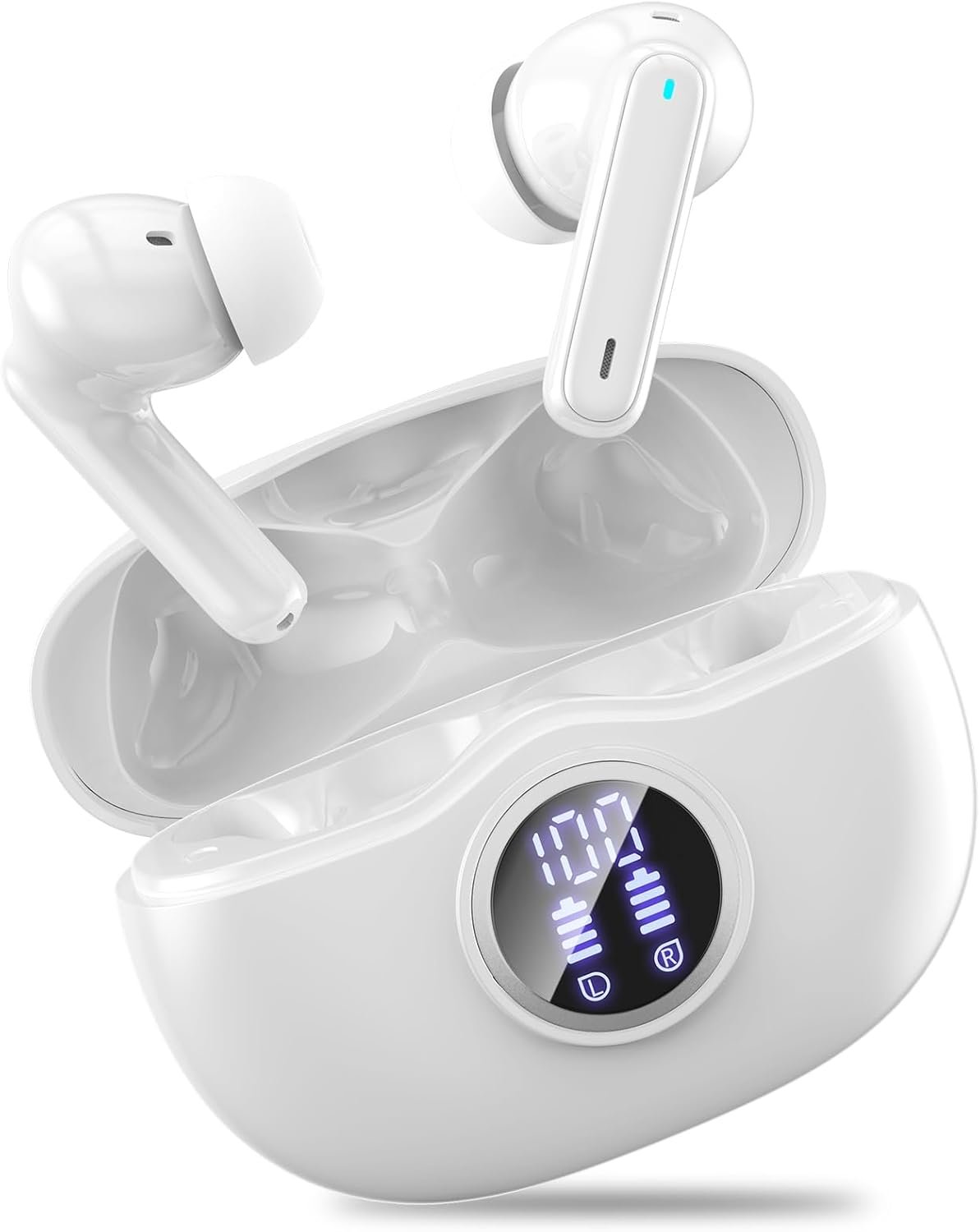



Wireless Earbuds, Bluetooth 5.3 Ear Buds Headphones with Digital Display: A Closer Look at the Fhumsh A10
Wireless earbuds have become a daily carry item for a lot of people, and the market now offers options built around very different priorities. Some focus on compactness, others on battery figures, and others on features aimed at workouts. The Fhumsh A10, sold under the descriptive title Wireless Earbuds, Bluetooth 5.3 Ear Buds Headphones with Digital Display, sits in the camp that tries to cover several of these priorities at once. It pairs a digital battery readout with a claimed long total playtime, an IPX7-rated case, earhooks, and Bluetooth 5.3. This review walks through what the listing actually states, what those features mean in practice, and where buyers should pay attention before deciding.
Design and Build
The A10 is built around a charging case that the listing describes as ultra-compact at 0.09 lbs and roughly 40% smaller than most headphones on the market. That size claim comes from the manufacturer, but the practical point is straightforward: a smaller case is easier to slip into a pocket or a fitness armband, which the listing specifically mentions as a design target. The earbuds themselves are listed at an ultra-light 0.008 lbs each, a figure the brand ties to staying secure during marathons.
Fit is addressed through two elements. First, the package includes three pairs of medical-grade gel tips in small, medium, and large, which the listing says are shaped to conform to a wide range of ear contours, including small ear canals. Second, the earbuds use reinforced earhooks, described as resistant to 8G of vibration, to help keep them in place during high-intensity interval training and mountain cycling. Earhooks change the character of an earbud — they add stability but also bulk — so anyone who prefers a flush, hook-free fit should note that this model uses them.
Features and Technology
The headline feature is the smart LED display. The screen shows real-time power levels for the charging case and for each earbud individually, expressed as a percentage from 0 to 100. In everyday use, that removes some of the guesswork around charging: instead of interpreting a blinking light or a color code, you get a number for each component. It is a small convenience, but one that matters for people who rely on earbuds through a long day or a training block.
Audio hardware is listed as new 13mm drivers, with the brand describing the output as HiFi stereo and citing latency under 0.05 seconds for gaming and movies. The listing also states that the connection is stronger and more stable with almost no delay when gaming or watching video. These are manufacturer claims rather than independently verified figures, so they should be read as the brand’s stated positioning. The same applies to the ENC noise cancelling and beamforming microphones, which the listing says enhance call clarity in winds up to 25mph.
Connectivity runs on Bluetooth 5.3. The listing claims 98% stable connectivity up to 15 meters, with roughly twice the wall penetration of Bluetooth 5.2, and positions this as useful for running or crowded commutes. Dual-device pairing is also included, allowing a switch between a laptop call and phone music.
Battery, Charging, and Water Resistance
Battery figures are among the more specific details in the listing. Each charge is stated to provide 8 hours of playtime, and the combination of earbuds and case is claimed to deliver a total of 50 hours of use. Charging is handled over USB Type-C, with a stated full charge time of 1.5 hours. The case carries an IPX7 waterproof rating, which is a rating for the case rather than a blanket claim about the earbuds.
For the earbuds themselves, the listing describes a waterproof mesh and an internal nano-coating intended to stop sweat from reaching and damaging the components. That is the basis for the workout and fitness positioning. It is worth being precise here: the source describes sweat protection as a design measure, not as a guarantee of unlimited water exposure, so the sensible reading is that the earbuds are built with sweat in mind rather than rated for swimming or submersion.
Performance and Everyday Experience
Putting the stated features together, the A10 is clearly aimed at active use. The earhooks, the three tip sizes, the sweat-oriented internal coating, and the compact case all point toward gym sessions, running, cycling, and similar activities. The digital display supports that use case too, since checking remaining power between sets or before a run takes only a glance.
The 13mm drivers and the low-latency claim suggest the earbuds are also intended for video and gaming, where audio delay is noticeable. The dual-device pairing is a practical addition for anyone who moves between a work laptop and a phone during the day. Call quality is addressed through beamforming microphones, with the brand citing windy conditions as the scenario those mics are meant to handle.
What the listing does not provide is detail on codec support, app-based EQ, or specific sound signature. Buyers who care about those specifics will not find them here, and it would be wrong to assume them. The honest summary is that the feature set is broad and activity-focused, with performance described in the brand’s own terms.
Who Is This Product Best For?
Based on the stated design and features, the A10 suits a few clear groups:
- Gym-goers and HIIT participants — earhooks, multiple tip sizes, and the sweat-protection design are all oriented toward training.
- Runners and cyclists — the listing names marathons, running, and mountain cycling as intended scenarios, supported by the light earbud weight and secure-fit design.
- Commuters — Bluetooth 5.3 with the stated range and wall-penetration claims is positioned for crowded environments.
- People juggling two devices — dual-device pairing covers switching between a laptop and a phone.
- Gamers and video watchers — the sub-0.05-second latency claim targets this group.
The listing also suggests the earbuds as a gift for festivals and birthdays and mentions work-from-home professionals and travel enthusiasts, so those are reasonable contexts to keep in mind. Anyone who dislikes earhooks, or who needs published codec details before buying, may want to look elsewhere.
Final Verdict
The Fhumsh A10 is a feature-dense set of wireless earbuds built around activity and convenience. The LED display showing individual earbud and case percentages is a genuinely useful touch, the stated 8-hour per-charge and 50-hour total figures are substantial on paper, and the combination of earhooks, three tip sizes, and sweat-oriented construction makes the workout focus coherent rather than decorative. Bluetooth 5.3, dual-device pairing, Type-C charging, and the compact case round out a practical package.
The caveats are equally clear. Several of the stronger claims — the latency figure, the connectivity stability percentage, the wind performance for calls, and the size comparison to other headphones — come from the manufacturer and are not independently verified in the supplied information. Sound quality is described in broad terms without codec or tuning detail. Buyers who want a secure, display-equipped earbud for training and daily switching between devices will find the A10’s stated design lines up with those needs; those who prioritize published audio specifications should treat the marketing figures with appropriate caution.
